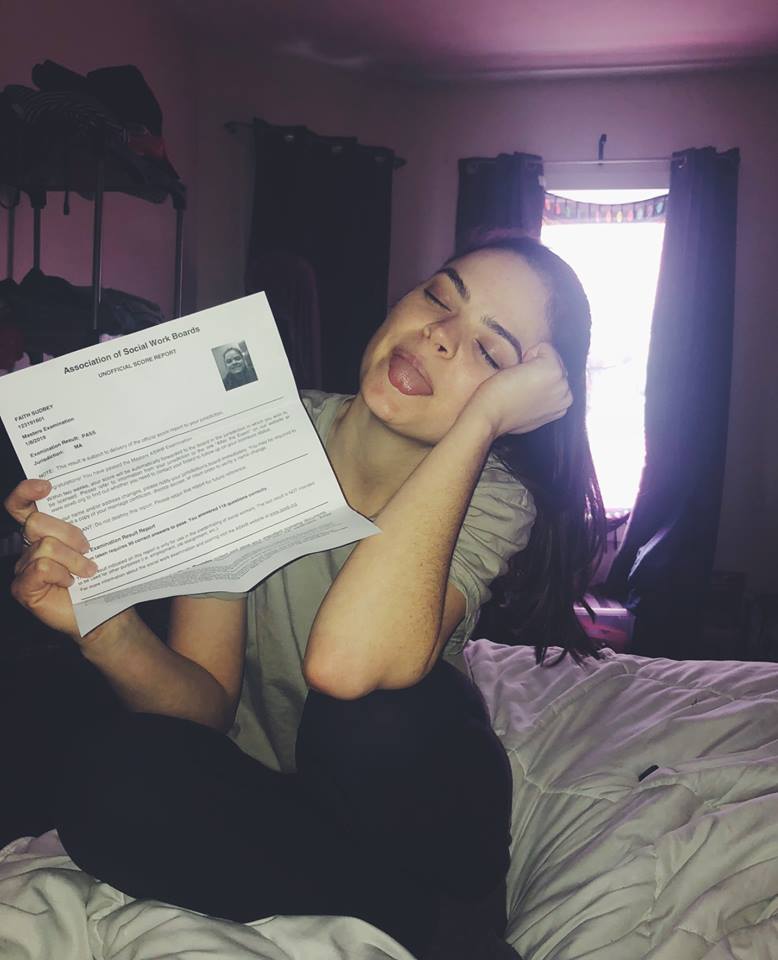
 What is the LCSW exam?
The Licensed Clinical Social Work (LCSW) exam is administered by the Association of Social Work Board (ASWB). The Clinical exam is the final, and most challenging, of the exams offered by the ASWB. Different states grant different titles for social workers who pass the ASWB Clinical exam. In most places, LCSW or LICSW are used.
Get started by choosing exams here.
Try SWTP's free practice test.
What's on the LCSW exam?
The LCSW exam, like all ASWB licensing exams, consists of 170 questions which are to be completed over a timed, four hour period. Of those questions, twenty pretest questions being tried out by the ASWB for possible inclusion in future editions of the exam. Tester questions do not count toward or against your final score.
The ASWB publishes an exam content outline, covering the knowledge, skills, and abilities (KSAs) that may be tested for on the exam. The Clinical exam breaks down this way:
HUMAN DEVELOPMENT, DIVERSITY, AND BEHAVIOR IN THE ENVIRONMENT (24%)
ASSESSMENT, DIAGNOSIS, AND TREATMENT PLANNING (30%)
PSYCHOTHERAPY, CLINICAL INTERVENTIONS, AND CASE MANAGEMENT (27%)
PROFESSIONAL VALUES AND ETHICS (19%)
The exam is designed to assess beginning clinical social work knowledge, skills, and abilities. So while the assessment, for example, could draw from anywhere in the DSM, it is far more likely that you will face questions based upon the common diagnoses that social workers encounter in day-to-day practice. Deep memorization of obscure criteria is less important than solid understanding of frequently seen conditions. Take care not to overstudy.
What are the questions like on the LCSW Exam?
ASWB licensing exams are all multiple choice, with four choices offered. The majority of questions tend to be in vignette form, laying out a client situation and asking for the BEST or NEXT step a social worker might take in that situation. There are no "all of the above" or "none of the above" answer choices. Trick questions are also not a feature of ASWB exams.
A question might look something like this:
A 21-year-old female client who appears noticeably underweight reports frequently forcing herself to vomit after meals in order to "stay thin and pretty." The MOST likely DSM diagnosis for this client is a type of:
A. Bulimia nervosa
B. Body dysmorphic disorder
C. Rumination disorder
D. Anorexia nervosa
As with many questions on the LCSW exam, you may be able to rule out a couple of answers and narrow down to two strong possibilities. For this item, bulimia and anorexia both seem plausible. To make the final choice, you must apply DSM knowledge carefully. Although self-induced vomiting is associated with bulimia, significantly low body weight is central to anorexia nervosa. In this scenario, the client’s underweight presentation and focus on weight suggest anorexia nervosa, binge-eating/purging type. Individuals with bulimia nervosa typically maintain weight within or above the normal range. The correct answer is D, anorexia nervosa.
Notice that the difference comes down to one key distinguishing feature—weight status. Many ASWB questions hinge on recognizing the detail that separates two reasonable answers.
What's the best way to prepare for the LCSW exam?
Practice exams are hands down the best way to prepare for the LCSW exam. Testing your knowledge and directing your studying through real time (four hours), full-length (170 question) practice tests is essential.
Good practice tests, like those offered by SWTP, offer repeat exposure to the exam-taking process and exam content simultaneously. Will you need breaks or a snack? Do you get worn out after the first 50 questions? It's ideal to know the answer to those questions before sitting down for the real thing. Having those basics answered ahead of time allows you to focus on the question right in front of you and make the right pick, A, B, C, or D.
SWTP has five complete 170-question practice tests, plus two booster tests—one all ethics and one all DSM. Each question includes detailed rationales and targeted guidance to help you understand why one strong answer is stronger than another.
SWTP exams really help. Ask Emily:
"I can't thank you enough for your program. I passed my clinical exam on the first attempt! I also used your exams when I took my Master's level exam (and passed). Your program was very helpful in understanding how the questions might be worded and what important information I needed to examine in the question as well as preparing for the exam in general. It also doesn't hurt that you give extra coupon codes to help us "high" salaried social workers purchase your exams so that we can continue to grow professionally!!!
Thank you, thank you, thank you!!! I have already recommended you to two other SW's that will be taking their clinical exam soon.
If you are on the fence about purchasing, I highly recommend it!"
